How an Oil Well Works
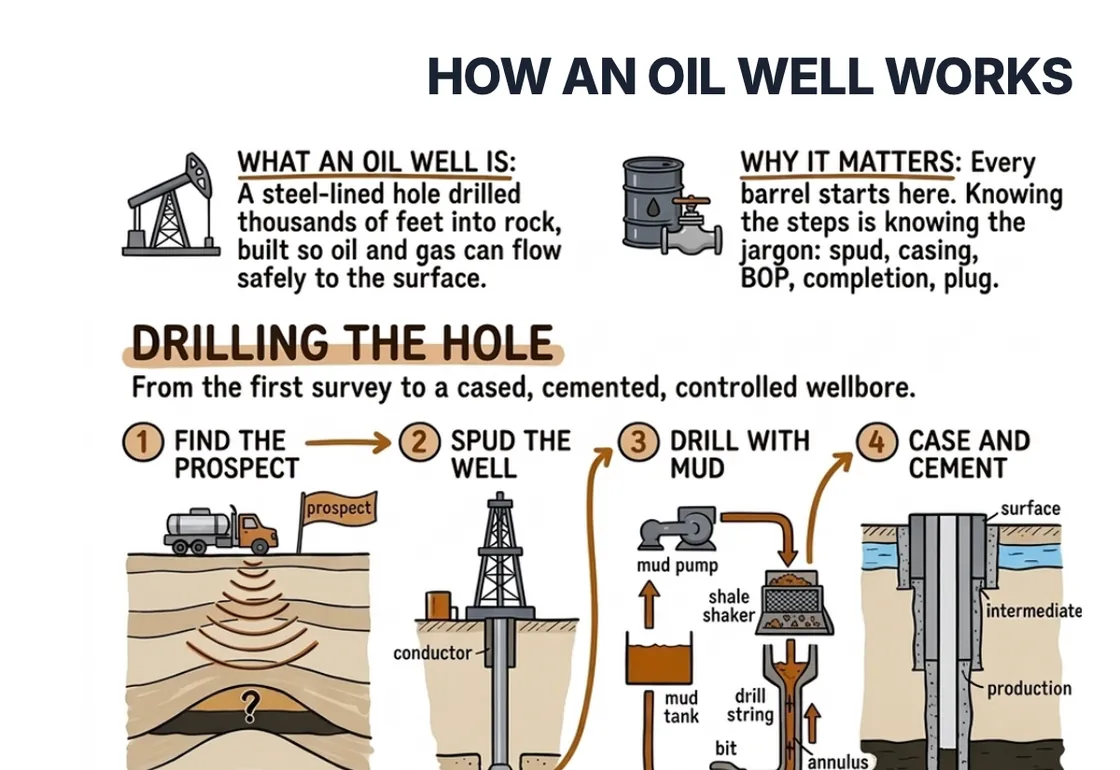
How an oil well is found, drilled, cased, controlled, completed, produced and plugged, with every term linked to its definition. Free to embed with a credit link.
339 definitions and illustrated guides for engineers, landmen, new hires and students. Free to read, no sign-up.
Often looked up: Heater Treater Oil in Place (OIP) Flowline Umbilical FPSO
Each guide walks through one process in eight illustrated steps, with a worked example and the terms you will meet along the way.
All guidesHow an oil well is found, drilled, cased, controlled, completed, produced and plugged, with every term linked to its definition. Free to embed with a credit link.
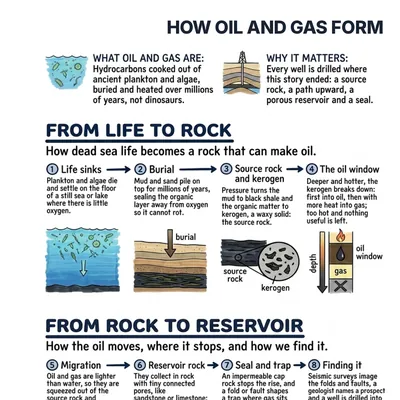
How oil and gas form, from plankton and burial through kerogen and the oil window to migration, reservoir,…
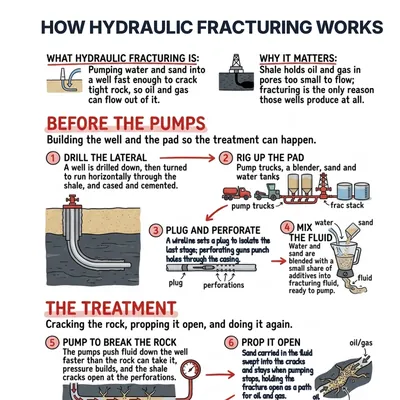
How hydraulic fracturing works, from drilling the lateral and plug-and-perf to pumping, propping, staging and flowback, with every…
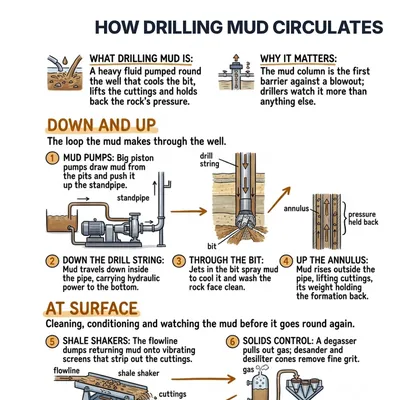
How drilling mud circulates, from the pumps and drill string to the annulus, shakers, solids control and the…
Ten areas of the business, from finding oil to paying for it.
Exploration and subsurface activities involve locating hydrocarbon deposits and evaluating the geological formations that contain them. Techniques such as seismic surveying, well logging, and reservoir modeling guide drilling decisions and optimize production.
Drilling and completions are core phases of oilfield development that transform a geological target into a functional well. The process includes well planning, bit selection, drilling, casing, cementing, and final preparation for hydrocarbon flow.
Stimulation and intervention encompass techniques that improve well flow and reservoir contact, such as hydraulic fracturing, acidizing, and workovers. These methods increase production rates, extend field life, and enhance overall recovery efficiency.
Production and operations encompass the activities that extract, process, and transport hydrocarbons from the wellbore to surface facilities. Effective flow management, facility design, and performance monitoring ensure maximum recovery and safety.
Reservoir management involves monitoring and adjusting production strategies to maintain pressure, optimize fluid flow, and extend field life. Improved recovery techniques such as water flooding, gas injection, and enhanced oil recovery increase the amount of extractable hydrocarbons.
Equipment, facilities, and infrastructure encompass the machinery, processing plants, pipelines, and support structures that enable oil extraction, transport, and refining. Understanding these components reveals how the industry maintains safety, efficiency, and production continuity.
Offshore and subsea operations involve extracting hydrocarbons from reservoirs located beneath the ocean floor. These activities use specialized platforms, pipelines, and remotely operated vehicles to drill, produce, and maintain wells in deep water environments.
Health, Safety, Environment and Integrity (HSEI) programs protect workers, communities, and ecosystems in oilfield operations. They integrate risk assessment, emergency response, and ethical standards to prevent accidents and pollution.
Project management, economics, and regulatory considerations intersect to shape every phase of oilfield development. Effective budgeting, risk assessment, and compliance strategies enable operators to optimize production while meeting legal and stakeholder expectations.
Digital and emerging technologies reshape oilfield operations by integrating IoT sensors, AI analytics, and cloud platforms. These tools enhance real-time monitoring, predictive maintenance, and decision-making, driving efficiency and safety across exploration and production.
Oilfield work runs on a vocabulary of its own. It blends geology, mechanical engineering, law, finance and rig-floor slang, and it has been growing for more than a century. A single misunderstood term can cost a day on location or a clause in a lease.
This glossary translates that language into plain English. It covers upstream exploration and drilling, midstream transport and downstream processing, and it decodes the acronyms people use every day, such as BOP, ESP and EOR. Whether you are reading a mud log, reviewing a habendum clause or starting your first week on a rig, each entry explains what the term means and how it is used.
It is a reference that defines the technical language, engineering terms, geological concepts, legal clauses and abbreviations used in the energy industry. Oilfield projects bring together geologists, engineers, roughnecks, landmen and safety officers, so shared terms keep drilling instructions, safety procedures and daily reports clear to everyone.
Upstream covers finding and producing oil and gas: seismic surveys, drilling and production. Midstream moves and stores it through pipelines, tankers, rail and storage. Downstream refines crude oil and processes natural gas into fuels, lubricants and petrochemicals.
Rigs, meetings and daily reports need fast, precise communication, so long names get shortened: blowout preventer becomes BOP and enhanced oil recovery becomes EOR. This glossary spells out those acronyms and explains what each one means in practice.
Reservoir engineers study the rock and fluids underground and plan how to recover them. Drilling engineers design and build the well safely through thousands of feet of rock. Production operators run the finished well day to day, including artificial lift, surface facilities and routine interventions.
Yes. It includes digital oilfield terms such as digital twins, automated drilling and fiber optic sensing, and energy transition terms such as carbon capture, utilization and storage (CCUS) and methane monitoring. New entries are added as the industry changes.